Showing posts with label oil. Show all posts

Sunday, 5 September 2021

E46 318i Touring: Replacing leaky Oil Cooler gasket [N42]

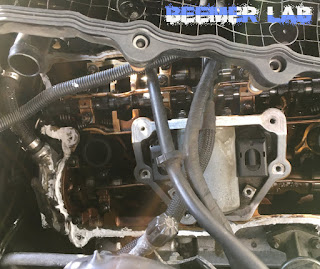
After fixing the major oil leak from the rocker-cover gasket [THIS POST], I noticed there was still some oil pooling on the under-tray and a fews spots dripping onto the road. I traced the source up the right side of the engine (looking from the front) and could see oil filling up some cavities in the cylinder-head to the left of the oil-cooler / filter housing, so determined this to be the culprit... yes, another common one, especially if the filter-housing has been removed for previous engine work.

A replacement gasket was just £6.59 from eBay and comes as a two piece set including the main gasket that sits between the housing and the cylinder-head, as well as a smaller gasket that sits between the oil-filter housing and the coolant fed heat-exchanger. This latter one hardly ever leaks, as it's very rare to find a filter-housing that has been split apart during engine work, but it's nice to have one anyway and you may find it worth the time to replace this one while the housing is removed, though I could not see any signs of leakage so didn't bother.


GUIDE:

1. Remove the lid to the air-con ducting that sits atop the firewall at the back of the engine by undoing the clips a quarter-turn, take out the pollen-filter and remove the weather-strip seal from the firewall.

2. Remove the air-con ducting itself by undoing the four screws using a T30-Torx socket and lifting it out.

3. Remove the rear right-side engine cover by undoing the two stud-nuts using a 10mm wrench.\

** Make sure you have a cloth / plenty of tissue to catch any oil that runs from the housing. **

4. Remove the three screws holding the oil-filter / cooler housing to the cylinder-head using a 10mm socket with a long extension bar. One is clearly visible in front of the housing, the other two being hidden down the back.

5. Lift the oil-filter / cooler housing upwards out of the head, catching any wayward oil and lift the housing clear, rotating it so as not to put too much strain on the coolant-hoses. The hoses do not need removing or any coolant draining for this job.

6. Remove the old gasket and clean both mating surfaces with a cloth and I find it always worth scraping any crud off with a razor-blade.

7. Insert the new gasket to the housing. A lug on one side sits in a notch in the housing so the gasket can only fit in one way. [If it's an older engine or the housing has been removed a few times before, it might be worth taking a belts-and-braces approach by applying some gasket sealant to the mating surface on the head, as I did with some white Corteco.]

8. Carefully place the filter/cooler housing back onto the cylinder-head, trying to spill as little oil as possible on the mating surface and reverse steps 4-1 to refit.

Wednesday, 20 May 2020

E46 318i Touring: Oil leak fixed! Rubber rocker-cover gasket was the culprit!

It's about time I got back to wrenching on some Beemers after a busy hiatus, so where better to start than with the massive oil-leak on my E46 318i Touring. The car hasn't seen much use over the winter months, but as I start to need it again for its cavernous load-lugging functions, I figured it was time to spend a bit more time getting it right.

I was going through about a cupful of oil every 100 miles or so (I think that is a pretty favourable estimate to be honest, more like half a litre!) and worse than the cost of all the topping-up, smoke continued to billow from not only the sides of the bonnet (hood) while stopped at traffic-lights, but also straight into the cabin with the blowers turned on. This meant for the last 12 months I have had the climate-control set to full recirculation mode and on low, making de-misting the windscreen a nightmare on colder days.


I could see the oil-leak was coming from the rear left side of the engine, as it so often the case with N42 engines and assumed it to be the vacuum-pump (like with my E46 318ci in this this post), but after removing the rocker-cover (cam-cover) I found it was actually the rubber gasket itself. The thick rubber gaskets tend to harden and go brittle over time and almost completely down the left side of the cam-cover there was noticeable leakage, primarily at the back corner, next to the vac-pump of course. The gap at the rear-left corner was so pronounced I feel you could have slipped a credit-card through with a little force and touched the back of the cam-shaft! This was allowing a constant drip of oil out onto the heat-shield and down onto the exhaust-manifold, as shown by the arrows in the picture and causing most, if not all of the smoke.

Luckily, I suppose, I have been working through the Covid epidemic, so I am classed as a 'key worker' and had a day off, so I managed to blag Euro Car Parts that it was essential work and instantly collect the new Elring gasket (£22, but eBay alternatives are as cheap as £9.50 if you can wait!) and some Corteco White instant gasket-sealant (£7), though they still had me waiting for an hour outside!


Knowing how prone the top-end seals of the N42 are to leaks and not wanting to take any chances of removing the rocker-cover again anytime soon, I slapped on a liberal bead of the Corteco sealant over the vacuum-pump ring and along the entire left-side (lower) surface of the cylinder-head top edge along with the new rubber-gasket. The job does not take long at all (I will post a guide soon), with removal and refitting of the cam-cover only taking around 30 minutes each and that's taking your time...

Needless to say, this has stopped the major part of my oil-leak in this area! Not only has the oily steam stopped from the sides of the bonnet while stationary, the smell/smoke from the climate vents has now ceased and the car is no longer consuming oil at a silly rate, so I would say job done! There is still a tiny weep of fresh oil coming from around this area, but nowhere near like before and, after a run where the engine is warm, there is no dripping pool on the under-tray! For the money I spent, the difference in convenience is worth vastly more! I would have spent the ~£30 I did in oil in a couple of weeks using the car daily, so if you have this problem, it's safe to say this is the culprit and get it sorted!

Wednesday, 8 October 2014

E36 Compact: M43 Oil Change + Filter Removal.

Got round to changing the oil and filter on the Compact, as I've been running it for a month with the mayonnaise filled concoction left from the dodgy head-gasket / cooling issue.

Removing Oil-Filter:
The filter-housing on the later M43 316i / 318i is right down in the bowels of the engine and impossible to get to easily, as they are on almost all other BMWs. The lid has no nut either to undo it from above, so the only way is to use an old-skool oil-filter removal tool from the side, only most of the engine prevents this.

The simplest way to get it off is to remove the fan-cowl and fan. This way there is just about enough room at the front of the engine to get a turn on the filter with the removal tool. I found a chain based removal tool works well, but a steel-belt one would probably be just as good. It isn't essential, but I removed the top inlet-manifold too, just to see what I was doing more clearly.

1. Remove the fan-cowl by undoing the two top screws with a 10mm socket and lifting it off, popping it out from the air-inlet ducts at either side.

2. Remove the two 8mm screws holding either side of the rear edge of the fan-housing at the top and lift the fan vertically up, sliding it out of the two bottom lugs.

3. Slide the removal-tool in from the front and there should now be room enough to get a turn on the filter-housing lid, even if it's as tight on as mine was.

Sunday, 14 September 2014

E60: Cracked lower timing-case - engine finished.

Yeah well that's torn it. Literally, torn it open. After all that effing about with the sump removal, finding the right piston and drilling off those snapped head bolts, I find a whopping great crack in the lower timing-case!


I wonder what caused this? Vibration from the swirl-flap doing its dance? High crankcase pressure from the dodgy piston? Who knows, but we can safely say that's where the oil leak was coming from!

It's a big enough job as it is to replace that single damaged piston, but to swap the lower timing-case as well involves stripping the entire front of the car, getting all the pulleys off and fully removing the crankshaft. Hmm, a lot of work and a lot more cost, this definitely calls for a replacement engine... Watch this space!!

Wednesday, 10 September 2014

E36 316i Compact: New head-gasket.

Well, it's been a busy month again in Beemer Lab and I've just bought a new house which hasn't helped. Firstly, I finally removed the stuck head-bolts from the E60, got the head off and found where my oil leak is coming from... The lower timing case has a big crack in it! It's too big a job to replace that and do the new piston, so it looks like the 530d does need a new engine after all, what a shame after my £500+ spend.

As there is no E46 progress still, I decided a cheap runaround BMW was needed on a temporary basis so I shelled out a quick £200 on an X-reg E36 316i Compact, again in Titansilver. It has 4 months tax and 10 months MOT so seemed ideal as a stop gap. That was until I went to pick up a fridge and it majorly overheated. After I limped home I found oil in the water, water in the oil and a constant bubbling from the radiator. Blown head gasket then!

I had to use it for 2 weeks in this state, only doing the 2 mile trip to work and no further, but still it was getting to max temp as I pulled up on the drive. The gasket was only £18 off eBay and is FAI. The job only took about 4 hours (oh the joys of working with a single cam!) and it is back on the road and running quite cool so far, though I will need to put it through its paces to find out if it was just a dodgy gasket or if there is a real cooling problem that's caused it.

I will cover the poor E60 and it's future in more detail soon. Oh, and I've also bought a new secondary air-pump or the E46 so watch this space. 3 Beemers and counting...

£18 delivered. eBay FTW still.
By gosh, that looks like some hot oil.
The centre two head-bolts [1 and 2] were finger loose when removed!
This has obviously allowed oil and water to mingle. Blast marks round
the front cylinder show where combustion was stopping water entering the head.
This whole head-gasket swap took about 4 hours, so how
hastily the last one was thrown on is disturbing...
Lots of burnt oil and split gasket over the head, but it cleaned up well.
Think I will leave cleaning the cooling system for another day though. The head is caked with 'rad-weld' type stuff.
Amazingly, after all that overheating, the head is straight as anything! BMW alloy heads are forgiving to say the least.
10 minutes with a razor-blade and the block is good as new. PIston don't look half bad either.
New gasket on. The re-tightening sequence is 30nm, 90 degrees and
another 90 degrees. I wonder if the last guy to work on it only did
the 30nm and forgot about the torque angling?

Saturday, 9 August 2014

E60: Oil Leak Verdict.

More bad news for the 5 Series I'm afraid. Got it up on the ramps at work with five mechanics and as many torches to finally see where the bulk of the oil is coming from. In this post [http://beemerlab.blogspot.co.uk/2014/07/e60-bad-oil-leak-was-it-running-too.html?m=0] my attention was solidly on the turbo oil-feed and return pipes, but further investigation has revealed that no oil is dripping from them and if they are leaking then it is only a seep, which is eventually building up on the underneath of the pipes. The main oil leak it would seem is running down the front of the engine. Unable to see where though or trace where the oil is running from due to the belts and pulleys covering the front of the block so well, I tentatively assumed it was coming from the front main crank-seal - oh dear. It stands to reason that swirl-flap damage could have unbalanced the crank somewhat and caused the front main-seal to leak, but this theory is stopped by two factors - 1. If oil was leaking so badly from the front crank-seal, it would be hitting the pulley and have the trademark 'spray pattern' in a circle around the main-pulley, and 2. If swirl-flap damage had unbalanced the crank enough to let this much oil out, then the engine would be a bit more recalcitrant that is being!


Pressurised oil?

So where is the oil coming from? We blasted the entire front of engine with brake-cleaner and stood back to watch where the oil arrived from. Thankfully we watched it pool and run down from above the main-pulley. The other lads suggested the usual suspects - rocker-cover gasket or a loose oil-way at the front of the block, but there is no denying signs of fresh oil are present everywhere on the engine where there is a gasket or seal. This means the oil is being forced out of these joints somehow by pressure building up in the crankcase and would explain how oil that cannot be from the frontal leak has made its way onto things that are nowhere near it, i.e the turbo feed/return pipes. It also explains my other big problem - oil entering the air-inlet. The worst case scenario is the main turbo-seal dumping oil right inside it. This makes for both a lot of oil getting blown into the engine, but also gives a smoke-machine effect out the back, the latter of which I have no signs of as yet.

Smoky CCV [Crankcase-Ventilator]?

I removed the rubber-hose that recirculates the CCV (crankcase-vent) back into the turbo while the engine was warm and running. Thick oily smoke was billowing out of the CCV, which I duly replaced [eBay £35], though it did not affect the problem and holding a hand in front of the smoking pipe for a minute leaves an oily residue. It would appear the oil is getting into the air-inlet by condensing down the CCV recirc pipe into the turbo impeller. This is definitely not normal CCV behaviour and finally gives a sure sign off abnormal crankcase pressure. Finally, with the car on ramps and the underbody-protection fully off it became clear that oil was dripping pretty bad from the back of the engine and pretty much everywhere else, even the sump.


Verdict:

I started another thread on BMW Land [http://www.bmwland.co.uk/forums/viewtopic.php?f=5&t=163497] and the torrent of 'I told you so' replies came in and backed up my fears about piston 6. The rings are stuck inside the piston and not making good compression. The lack of power isn't really being picked up under normal driving, but the blow-by is so bad that it's allowing combustion pressure straight into the crankcase, hence burnt oil and exhaust smoke pouring out of the CCV. You wouldn't think a swirl-flap bouncing round could cause the rings to do this, but check the picture below. Well, you live and learn. This weekend I will be stripping the sump off the car and then, of course, the head is coming back off, which means more new bolts and another new gasket, coming to about £120. Sadly, even BMW cannot tell me exactly which piston my engine has from neither my reg. or VIN, so I will have to pop it out the top of the block and identify it before ordering one as they're over £200, but this means the car is off the road at least another week. I managed 268.5 miles between engine rebuilds... 

Photo courtesy of http://bmwspecialistreading.co.uk/

Monday, 28 July 2014

E60: Bad Oil Leak - was it running too well after rebuild?!

I've covered 125 miles on the new head / ground piston since putting the engine back together last weekend and the car has performed great. However, I was checking the oil and finding it hardly showing on the dipstick. On Wednesday night I poured in another half litre of oil and it began to show on the dipstick, about one third up. It was in the same place the following morning, so I poured in another half litre, got it up to near max on the dipstick and carried on using the car. Almost immediately I could smell fresh oil from the heater / air-con. There had been no dropped oil for the first few days [engine under-trays still off], but there sure was now. A small patch every time I pulled up and stopped the engine. Some investigation revealed no oil to be leaking while the engine is cold, but once up to temp. it is a constant drip from underneath the turbo area and a few drips from elsewhere, mainly from oil running along the sway-bar and cross-members. Oil is also ending up in the air-intake and being burned by the engine. This is not good!

This was after running the engine for 2 minutes on a fresh piece of newspaper!
Here is where the bulk of it is coming from - the turbo oil-feed pipe. It may also be from the oil-return pipe, located under the turbo. Hopefully this is too much oil or oil-pressure finding its way out through the loosest seals. If not, the turbo seals have gone and the blower is on its way out.
Oil is flying into the air-intake also, so the injector tips have become quite cruddy with oily residue. Nasty, though the nozzles remain quite clean and all 6 appear to be working OK.
This is the breakdown:
  • Simply an overfill - oil-pressure is too high and leaking from multiple loose seals.
  • Turbo oil-seal gone - oil is gushing from the middle of the turbo and getting into the inlet.
  • Blocked CCV - the crankcase can't breathe is causing high oil-pressure and leaks.
  • Complete turbo failure - bits of swirl-flap unbalanced the exhaust-wheel and wrecked the spindle, oil is now leaking from the centre-bearing and the blower is finished. 
There is a little bit of lateral play in the spindle, so that horrible last option could be the case, but at least a re-con turbo is only £325 on eBay, not too bad. Hopefully it's the first option and dropping some oil back out of this thing could cut the leak right back. Oil getting into my inlet is not good news for a diesel though and I could end up with my engine running on its own oil and unable to turn off, at which point I hope there is enough room in the traffic to stall the motor out!

My plan of action is thus:
  • Drain 2 litres of oil back out. [I can always put more back in.]
  • Watch for blue-smoke developing. [None as yet, but a bit of white smoke on startup.]
  • Get someone at work to check play in the turbo-spindle. [They say it's passable and a leaky turbo would give bad smoke, a broken one would be noticeable.]
  • Replace CCV [crankcase-ventilator]. [eBay £37.50 delivered.]
  • Replace oil-filter. [Euro Car Parts £5.99.]
  • Replace copper-washers on turbo oil-feed pipe.
  • Replace turbo... gulp.

Sunday, 20 July 2014

E46: Inlet full of oil! Re-con time.

Removed the inlet-manifold to check the CCV [crankcase-ventilator], crankshaft-sensor and main wiring-loom / connections. It didn't look too bad underneath, though there are some signs of a stuck CCV valve. I put the manifold down next to the car while I was working and after 5 minutes I noticed a large pool of dirty oil had run out of the throttle-body, so I placed that end in a bowl, jammed the butterfly open and leant the manifold on its end. Another 1/4 pint of oil ran out of it and today I removed the throttle-body entirely and managed to get about half as much again. More is coming, so I've blasted carb-cleaner back through the inlet-ports and left it to run down.


So either the piston-rings are completely shot and are leaking that much oil back up into the inlet, in which case the engine wouldn't run... or it's one heck of a stuck CCV. In this case, it would appear the crankcase-vent valve has stuck closed, which is allowing pressure to build up and pump oil back through the clean side of the CCV-system, dumping it right into the top of the throttle-body! Rather than creating a vacuum in the air-inlet that keeps the car at a decent idle, the CCV is pumping combustion pressure instead and covering all the sensors with hot oil. Not good. This is the most poorly engine I've ever seen.

While the throttle-body is off I may as well give it a good clean, along with all the sensors that had filled up to the wiring-connector with the pressurised oil. Even if this doesn't completely clear the rough running faults, it has certainly given the engine a new lease of like and it never does any harm to flush everything out and eliminate any further problems in the inlet.

Monday, 14 July 2014

E46: Vacuum-pump severe failure...

With a new servo and master-cylinder, but still no brake assistance, I decided the vacuum-pump must be leaking air. I whipped it off, only 3 bolts and no need to remove rocker-cover etc., and opened it up. This is what I found...

This chamber should be full of air, not oil. The pump bolts on to the back end of one camshaft, which turns a spinning-boss. A plastic-bar slides up and down in the spinning-boss and creates a constant vacuum into the servo to help 'suck' the brake-pedal down when you brake. My plastic bar is missing. Where is it? Well, it's smashed into pieces lying in the oil.
After a clean up it was a decent pump-body and would work fine with a new O-ring and plastic-bar. They sell O-ring kits for the N42 vac-pump separately, but plastic-bars they do not, so I bought the pump from the same donor car as the servo + M/C. All pieces seem to have sheared off with a clean break, the bar was literally blown apart, except for one of the round end-caps (the tiny piece in the middle of the pile in the photo). That had been spread into thin strips as it broke off, so it looks like that end contacted the side of the case, spread into fronds and jammed the plastic-bar, which promptly blew up. How though? Did the timing slip unbalance the camshaft enough to wreck the pump? Or did the plastic-bar break apart and jam the pump, causing the camshaft to stop briefly and the timing to slip in the first place? Hmm...
Another side effect of the vac-pump failing was a terrific oil leak. The O-ring seal had gone completely and the spinning-boss was acting like a mini oil-pump, sending a constant stream down the back of the head onto the hot exhaust [bottom of the pic]. The pressure also made the vacuum-hose connector, normally only filled with air, to leak at the jubilee clip and pour oil onto the gearbox-housing [middle of pic]. After removing the pump a huge third pool of oil arrived. This was what had run out of the vacuum-hose to the brake-servo after disconnecting.

Saturday, 12 July 2014

E60: Engine Autopsy Verdict.

Well, contrary to my earlier verdict of no damage to the head, a bit of informed explanation reveals the corroded surfaces in cyl. 6 are in fact battered metal from the where bits of my swirl flap were bouncing around inside it. Not good!

After having my photos pored over by the engine diagnosis experts on BMW Land, the best version of events of that fateful Tuesday are below:

1. Swirl flap no. 4 breaks up and bits enter cyl. 4.
2. Inlet valves jamming open on cyl. 4 cause a backfire and blasts the loose remains of the swirl flap into the intake plenum.
3. The turbo forces the swirl flap remains along the plenum, with bits ending up in cyl. 5 and the majority entering cyl. 6.
4. Cylinders 4 and 5 continue to fire with slight lack of compression.
5. Trapped debris in cyl. 6 begins to ricochet around, causing damage to the alloy piston-crown and the top of the combustion-chamber in the head until the inlet valves cannot close fully and compression is lost entirely.

Worst bits:

  • Cylinder-head is finished. Valve-ports on cyl. 4, 5 and 6 need regrinding and fitting with some new valves. The top of the combustion chamber in cyl. 6 needs completely regrinding into shape.
Best bit:
  • The engine still turns freely, cyl. 4 and 5 are virtually damage free and do not need replacing.
  • Piston 6 compresses in the block still, so no damage to piston-rings.
  • There is no damage or scoring to the cylinder walls.

THE REPAIR [in theory...]
  • Repairing the head will cost ~£350, the cheapest Birkenhead-Engines can do and may still need further work, so a replacement is needed. Birkenhead-Engines say they have one such in stock, removed from another E60 530d, though what year they are unsure. It is not re-con and they say I can take my chances for a mere £200, but at least they know the valves etc. all work so it looks like this is the way to go.
  • As long as I remove any tiny debris from cyls. 4 and 5, I am happy that they are working 99% as well as they should and do not need any repair.
  • Cyl. 6 is battered and, although it is compressing in the block, the jagged metal crown will mess up proper combustion even if it fires ok. Worse, bits of the jagged alloy will probably break off during combustion and ping around the cylinder some more, potentially messing up the valves again so really the piston needs replacing.
  • Not only is finding a single replacement piston very difficult, the job to replace it requires removal of the sump and big-end shell. This, with all the under-trays and cross-members is a colossal task in itself and, with the car parked on loose gravel, it's looking like a no-go.
  • The short-cut solution to piston-6 looks like it's going to be a jenky regrind with the piston still in the engine. I will turn the crank by hand so that piston-6 is in its topmost position and get in there with a die-grinder, removing all the proud bits of metal and re-shaping the 'swirl-pot' and piston-crown as well can be. This ultimate bodge could be the end of a relatively unscathed engine. It could also be the only way to get the E60 back on the road quickly and with a minimum of fuss... Fingers crossed.
COST:
  • Replacement cylinder-head: £225. [Birkenhead Engines]
  • New head-gasket: £85.55. [Euro Car Parts]
  • New head-bolts: £37.48. [eBay: dusty789blue]
  • Swirl-Flap Blanking Plates: £20.99. [eBay: myldanautodesignltd]
  • New thermostat: £33.99. [I broke the housing - Ebay: carpartssaver]
  • Oil: £85.98. [Halfords, own-brand BMW Fully Syn. 5w30]
  • Coolant: £22.99. [Halfords, Comma G48]
TOTAL: £511.98.